
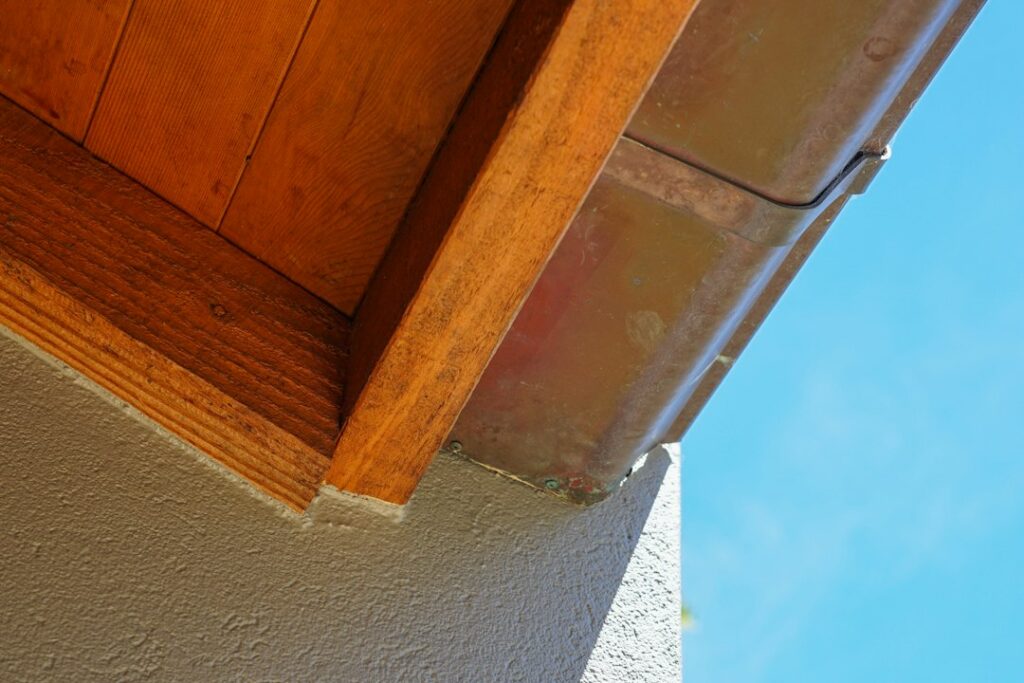
What are soffits and fascia?
Soffits and fascia are the finished components that protect the lower edges of a roof. The soffit covers the underside of the roof overhang, while the fascia is the vertical board or trim along the roof edge where gutters are commonly attached.
Together, they help manage airflow, shed water, protect exposed roof framing, and give the roofline a finished appearance. Although both parts are easy to overlook from ground level, damage to either one can allow moisture, insects, and cold air into areas that are difficult to inspect.
What does the soffit do?
A soffit closes the open space beneath a roof overhang. Many soffits contain small perforations or vents that allow air to enter the attic through the eaves.
This airflow is part of the attic ventilation system. Fresh air entering through the soffits can move upward toward ridge or roof vents, helping reduce excessive heat and moisture in the attic. Proper ventilation can help limit:
- Condensation on the underside of the roof
- Moisture-related deterioration of roof sheathing
- Damp insulation
- Mold growth caused by persistent humidity
- Ice buildup along roof edges during freezing weather
Soffit vents should remain open and unobstructed. Insulation that has shifted into the eave space can block airflow, even when the visible soffit appears to be in good condition.
What does the fascia do?
Fascia forms the outer edge of the roof and commonly supports the gutter system. It also covers the ends of roof rafters or trusses, helping keep those structural components protected from direct exposure.
A sound fascia board should be firm, reasonably straight, and securely connected. If it becomes soft or distorted, the problem may extend beyond the trim itself. Water can travel behind the fascia, reach the roof edge, and affect the sheathing, rafter ends, insulation, or wall framing.
Fascia also helps direct water into the gutters. If the roof edge is uneven or the fascia has pulled away, gutters may sag or develop gaps that allow water to run down exterior walls.
Why do soffits and fascia matter in Salamanca, NY?
Seasonal weather places repeated stress on roof edges. Snow, freezing temperatures, wind-driven rain, ice formation, and spring thaw cycles can expose weaknesses in soffits, fascia, gutters, and roof flashing.
Older homes may have wood soffits or fascia that have been painted several times. These materials can perform well when kept dry, but small openings around joints, fasteners, or roof transitions may allow water to enter. Once moisture becomes trapped behind painted surfaces, deterioration can progress out of view.
Cold-weather conditions create additional concerns:
- Ice can form along roof edges and place weight on gutters and fascia.
- Snow and meltwater can expose gaps at the eaves.
- Repeated freezing and thawing can enlarge cracks.
- Wind can loosen panels or trim that already have weakened fasteners.
- Heavy summer humidity can contribute to attic condensation if ventilation is inadequate.
These problems do not always appear immediately after a storm. Some develop gradually and become noticeable only when paint peels, gutters sag, or staining appears inside the attic.
How can a homeowner recognize soffit or fascia damage?
Visible warning signs often begin at the roofline. Look for:
- Peeling, bubbling, or blistered paint
- Soft, crumbly, or swollen wood
- Dark staining around soffit panels
- Loose, cracked, or sagging sections
- Open seams between trim pieces
- Missing vent screens
- Pest entry holes
- Gutters pulling away from the fascia
- Water marks near attic eaves
- Daylight visible through areas that should be closed

A small discoloration does not always mean the entire roof edge needs replacement. The source may be a failed gutter joint, damaged flashing, an overflowing gutter, or water traveling from a higher roof surface. Identifying the path of the water is more useful than treating only the visible stain.
Are soffit vents and roof vents the same thing?
No. Soffit vents are intake vents, while ridge, box, gable, or other upper-level vents usually allow warm, moist air to leave the attic.
A balanced ventilation system needs both intake and exhaust. Adding more exhaust vents without enough intake airflow may not solve a ventilation problem. In some cases, it can reduce the effectiveness of the system by pulling air from unintended openings around light fixtures, attic hatches, or wall cavities.
Ventilation should also be separated from air sealing. Attic air leaks can carry household moisture into cold areas, while soffit vents are designed to move outdoor air through the roof assembly. These are different functions and may require different corrections.
What materials are used for soffits and fascia?
Common materials include wood, aluminum, vinyl, and composite products. Each has different maintenance requirements.
Wood can be painted and repaired in sections, but it is vulnerable to rot if exposed to repeated moisture.
Aluminum resists rot and is often formed or installed as a protective covering over wood. It can dent, loosen, or develop gaps at seams.
Vinyl is lightweight and does not rot, but it can crack in cold weather or become distorted by impact and heat.
Composite materials may resist moisture better than traditional wood, although the surrounding joints, fasteners, and framing still need protection.
The visible covering is not always the structural part. A metal or vinyl soffit may conceal damaged wood behind it, so a firm appearance from the ground does not guarantee that the underlying roof edge is sound.
How should soffits and fascia be inspected?
A basic ground-level inspection can be done safely with binoculars. Check the roofline after heavy rain, strong wind, or the spring thaw, when moisture-related issues may be easier to spot.
From the attic, look near the eaves for damp insulation, darkened wood, frost, staining, or blocked ventilation channels. Avoid stepping on areas that are not designed to support body weight, and use caution around exposed nails, wiring, and limited-clearance spaces.
Ladder work and roof-edge repairs involve fall hazards. Conditions become more dangerous when surfaces are wet, icy, snow-covered, or unstable. Safety concerns, suspected structural damage, or deterioration near electrical components warrant qualified assistance rather than improvised repairs.
Can damaged soffits and fascia be repaired?
Minor damage may involve replacing a short section, securing a loose panel, clearing a blocked vent, sealing an appropriate joint, or correcting a gutter connection. More extensive deterioration may require removal of the visible material so the roof edge, sheathing, and framing can be examined.
Painting over soft wood, covering an open seam without addressing the water source, or adding more caulk to a repeatedly wet joint usually provides only a temporary appearance improvement. Repairs last longer when they address the reason moisture reached the area in the first place.
The most useful maintenance is routine observation: keep gutters clear, watch for overflow marks, inspect after severe weather, and make sure soffit vents are not blocked by insulation, nests, paint, or debris. Properly maintained soffits and fascia help the roof edge manage water and airflow through every season.
